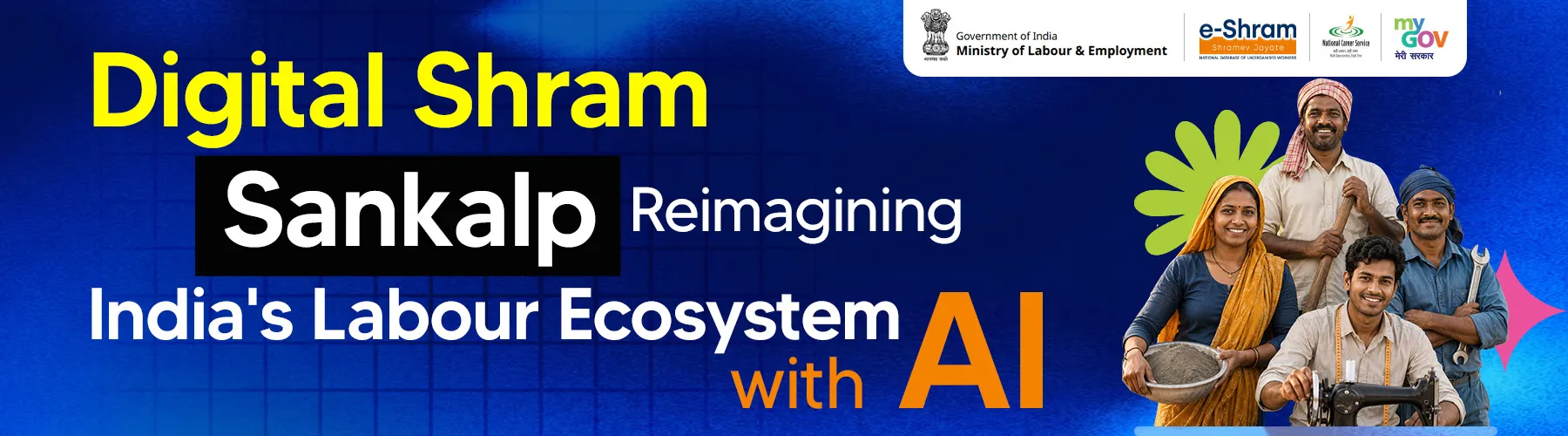
The Ministry of Labour & Employment is one of India’s oldest and most significant ministries, dedicated to safeguarding workers’ rights and promoting their welfare, especially among economically weaker and disadvantaged sections. It strives to ensure fair working conditions, enhance workplace well-being, expand employment opportunities, and strengthen vocational skill development. In line with India’s economic reforms, the Ministry advances social security and worker welfare across organized and unorganized sectors through labour laws covering wages, occupational safety, industrial relations, employment conditions, and social protection, including the implementation of the four Labour Codes. https://www.labour.gov.in/ministry
eShram, launched in August 2021, is India’s first national database of unorganized workers, including migrant, construction, agricultural, domestic, and platform workers. Over 31.82 crore unorganised workers have been registered on eShram Portal. The platform currently integrates 15 social security/welfare schemes. Integrated with platforms such as NCS, PM-SYM, myScheme, and SIDH, eShram connects workers to employment, skilling, and welfare opportunities. Registrations combine Aadhaar-based eKYC with self-declared information, and each worker receives a unique 12-digit Universal Account Number (UAN). Registration is available through self-service digital channels and assisted centres. Its secure data-sharing framework also supports targeted delivery of welfare benefits. https://eshram.gov.in/e-shram-portal
The National Career Service, launched in 2015, is a technology-driven employment platform connecting job seekers, employers, counsellors, and training providers. It offers job matching, career guidance, apprenticeship and internship opportunities, skill development opportunities, and job fair access. It also provides a host of AI services like resume building, skill gap analysis, interview coach etc for job seekers. With data covering more than 3,000 occupations across 53 sectors, NCS enhances employability through transparent and inclusive services. http://betacloud.ncs.gov.in/
The Shram Suvidha Portal 2.0 simplifies labour law compliance through a unified digital interface for registrations, licensing, inspections, and returns. Its upgraded version aligns with the OSH & WC Code, 2020 and Code on Social Security, 2020, enabling streamlined compliance, auto registration, single annual returns, transparent risk-based inspections, and simplified licensing, including a Single All-India Licence for multi-state operations. Together, these initiatives drive inclusive and sustainable growth. https://shramsuvidha.gov.in/
To further enhance and utilise eShram, NCS and Shram Suvidha portals at their optimum level, MoLE in collaboration with MyGov envisages to conduct an Ideation Hackathon (Ideathon). The Ideation Hackathon involves coming up with ideas, and methodologies where people with different skill sets, background come together to solve the given challenges/ problem statements. It is expected to provide the creative modern ways to enhance the utility of eShram, NCS and Shram Suvidha portals.
The broad objective of the proposed hackathon is to engage Young Minds, IT Start-Ups/ Entrepreneurs, IITians, Software Companies to share their innovative ideas around digital solutions for eShram, NCS and Shram Suvidha to enhance their overall functioning and utilization. The proposed solutions/ ideas should be in line with the Ministry's digital modernization roadmap such as: -
Note: It is important to consider data privacy & security while proposing integration/ implementation of the proposed ideas and solutions. The proposed ideas/ solutions should be in accordance with the Digital Personal Data Protection Act 2023, UIDAI and MeitY guidelines.
Below are few problem statements written for which Ministry of Labour & Employment is looking to receive modern, innovative and creative ideas through this Ideathon:
How might we build a consent-based, secure, and privacy preserving migrant tracking capability within eShram that enables location updates, migration heatmaps, predictive movement models, and simplified check in mechanisms to better inform welfare delivery for migrant workers?
What solutions can effectively motivate and assist workers to regularly update key information (address, mobile number, occupation, skills, etc.) on eShram by leveraging multilingual audio interfaces, chatbots, IVR/SMS workflows, predictive nudges, profile completeness scoring, and gamified engagement?
How might we create an accessible, mobile friendly AI interview readiness toolkit including mock simulators, voice based practice, resume to job fit scoring, behavioural question generators, and soft skills assessments to support job seekers registered on NCS?
How to strengthen awareness and outreach initiatives for the portals, while instituting robust monitoring, regulatory, and technological measures to prevent, detect and mitigate fraudulent platforms, ensuring secure and reliable access to employment related services for all citizens.
How can AI-enabled technologies and automated document-reading tools be utilised to enable intelligent document (PDFs, Scanned pdf/ image, Images) analysis, interpret compliances requirements under new labour codes, automatically flags anomalies, discrepancies, missing fields or non- compliance etc. and send automated alerts to employers and inspectors-cum-facilitator. Solution should also be able to generate a risk-based compliance scorecard for establishments.
How might we design voice-first, icon driven, multilingual, and disability inclusive interfaces along with assistive technologies such as text to speech, speech-to-text and simplified navigation to ensure that eShram, NCS and Shram Suvidha platforms are fully accessible to all workers?
How might we design intuitive and intelligent digital onboarding and profile management journeys for eShram, NCS and Shram Suvidha that simplify registration, enable one click eligibility checks for jobs and schemes, and support rapid profile updates to significantly improve user experience across platforms?
How can AI/ML driven tools be developed to detect and correct data imprecisions such as incorrect occupation codes, invalid contact numbers, and inter database inconsistencies along with user friendly correction mechanisms and backend validation engines to significantly enhance data integrity?
How can advanced analytics and visualization tools be developed to deliver real time insights such as migration patterns, skill cluster distributions, scheme uptake, district level labour risks, and predictive workforce trends - to support evidence based planning and policy decisions?
How can skill gap analysis and AI powered recommendation systems be developed using NCS profile and vacancy data to suggest relevant courses, wage uplift pathways, region specific job roles, government funded training opportunities, and track training to placement outcomes?
What digital tools can help employers identify verified and job ready talent using trust markers (EPFO/ESIC), skill availability heatmaps, wage benchmarking, candidate readiness scoring, and digital support for large scale hiring drives and job fairs?
How can the NCS be developed as a citizen-centric Digital Public Infrastructure (DPI) that provides seamless access to employment, skilling, career counselling, internships, apprenticeships, and livelihood opportunities by enabling secure and interoperable integration with Government platforms, employers, training providers, and other ecosystem stakeholders?
Participants are expected to understand the problem statement and provide potential solutions/ innovative ideas to these problems. They are expected to prepare and submitted solutions/ ideas in Power Point presentation, Word Document and/or PDF format (not more than 500 words for each problem statement) within prescribed file size limit.
Event |
Date |
Remarks |
Start Date |
5th August 2026 |
Official launch of this Ideathon on the Innovate India Platform |
End Date |
18th September 2026 |
Individuals/ Teams to register and submit their ideas for selected problem statement(s) (One or Multiple) |
The Ministry of Labour & Employment will constitute an Evaluation/Selection Committee for shortlisting of top ideas under the said activity. The evaluation/ selection committee will submit a report to the Ministy basis on the below listed selection criteria. Top 5 ideas will be selected and awarded.
# |
Criteria |
Description |
1 |
Relevance to Problem Statement |
|
2 |
Innovation & Originality |
|
3 |
Feasibility & Implementability |
|
4 |
Impact Potential |
|
5 |
User Experience & Accessibility |
|
6 |
Data Security & Privacy |
|
7 |
Sustainability & Long-Term Value |
|
8 |
Clarity of Presentation |
|
Key Terms and conditions for the hackathon are as under; all participants are to abide by these terms and conditions.
By submitting an entry, participants agree to abide by all the terms and conditions mentioned above.
